
The Rudest Question: “Why are you so shy?”

“Why are you so shy?”

This seemingly innocent question is the most counter-productive and really, deflating, thing someone that struggles with social anxiety* can be asked.

The question implies that there was some sort of deliberate choice in the matter, that people wake up each morning and decide they are going to go about their day timidly while harboring a fear of social judgment, like they were choosing their shirt and tie.

Worse, the question is almost always asked out of pity or contempt and rarely as an attempt to understand or help.

And it makes you feel like something is wrong with you. Something pathological. Like you are defective.

For a long time, I convinced myself I was these things and that I had many other ‘deficiencies’.

Really, I only felt comfortable interacting with those that I had been around for an extended period of time in a ‘safe’ environment, such as a classroom. The lengths at which I would avoid interaction knew no bounds:

  • I used to be too shy to call someone on the phone in junior high school and ask what the homework assignment was. Yes, I would literally rather take a bad grade than talk on the phone with a classmate.
  • I once made up a story about a friend having car trouble to avoid spending a whole evening with a girl I hardly knew and her friend at a baseball game.
  • On more than one occasion I feigned receiving a phone call instead of enduring the torment of standing and waiting with a group of people that I didn’t really know.

And these were all as a teenager (maybe 20 or 21 for the second one). Imagine the stories a grown adult that struggles with a full-blown social phobia could tell.

Being shy sucks. Wanting to be able to participate in the social world around you, wanting more than anything to be able to interact (seemingly) effortlessly like everyone else seems to do, but instead feeling like nothing more than a spectator. Basically, it feels like being a prisoner to your own mind.

So don’t ask people this.

There is really no possible way for the Shy Question to be asked without it sounding accusatory. It automatically puts a shy—somebody already in full-guard—on the defensive even more. The question implies that not speaking is wrong, yet ironically the declination to speak can in part be traced to a fear of saying the ‘wrong’ thing. This sub-communicates “you can’t do anything right.”

Damned if you do, damned if you don’t.

I’m not proposing that shys should be handled with kid gloves—I believe in most cases the fastest way to break the shell (like with anything) is immersion and repeated practice—but imagine the limiting beliefs this question can instill in a child.

Even if it’s not from a place of ill-will, it’s all counter-productive to what you are really trying to say, which is “Would you like to join the conversation?”

Of course there is no need to be that deliberate about it. Invite the person in subtly. Ask them their opinion on whatever it is being talked about. Ask what the best part of their day was, or if they have any exciting plans for the weekend. Extroverts make their own invitation; introverts and shys sometimes need an invitation to the conversation if it’s not about something they are super passionate for.

Recognize that this person is not in their ideal social setting, and help ease them into it. Only after doing this and showing them that there is nothing to fear, will you defeat the urge to ask them this question to begin with, because they’ll no longer feel anxious.0d4a84d18f36bbf72f7489def114378e
Again, I’m not advocating social handholding; only social awareness and empathy. Not bothering to interact with someone because they’ve been pegged as shy or as someone who doesn’t talk becomes a self-perpetuating, self-fulfilling prophecy for both parties.

An example of this can be found in a study discussed in the book Influence by Robert B. Cialdini:

“Carlos (a young student) was not very articulate in English, his second language, and because he was often ridiculed when he had spoken up in the past, he had learned over the years to keep quiet in class. We might even say that Carlos and the teacher had entered into a conspiracy of silence. He would become anonymous, buried in the bustle of classroom activity, and not be embarrassed by having to stumble over answers; she, in turn, would not call on him.

Her decision probably came from the purest of motives; she didn’t want to humiliate him, or watch the other kids make fun of him. But by ignoring Carlos, the teacher had, in effect, written him off. She was implying that he was not worth bothering with; at least that was the message the other kids got. If the teacher wasn’t calling on Carlos, it must be because Carlos is stupid. It is likely that Carlos himself came to the same conclusion.”

The chapter goes on to discuss the jigsaw learning method, in which each student in a classroom is given a set of facts that will appear on a test to be given that same day.

To learn everything that is going to be covered on the assessment, the students must ‘interview’ each classmate to learn their respective pieces of information. Not only does this open communication avenues between the outgoing children and those that are a little more reserved, it provides positive reinforcement to all, showing that both the Carloses and everyone else can all contribute value:

“It began to dawn on these kids that the only chance they had to learn about Carlos’s segment was by paying attention to what Carlos had to say. […] Instead of teasing Carlos or ignoring him, they learned to draw him out, to ask the questions that made it easier  for him to explain out loud what was in his head. Carlos, in turn, relaxed more, and this improved his ability to communicate. After a couple of weeks, the children concluded that Carlos wasn’t nearly as dumb at they thought he was. They saw things in him they hadn’t seen before. They began to like him more, and Carlos began to enjoy school more and think of his classmates not as tormentors, but as friends.”

Another solution to encourage socialization at younger ages comes from the research of psychologist Robert O’Connor with socially withdrawn preschool children (can also be read about in Influence):

“We have all seen children of this sort, terribly shy, standing alone at the fringes of the games and groupings of their peers. O’Connor worried that a long-term pattern of isolation was forming, even at an early age, that would create persistent difficulties in social comfort and adjustment through adulthood. In an attempt to reverse the pattern, O’Connor made a film containing eleven different scenes in a nursery-school setting. Each scene began by showing a different solitary child watching some ongoing social activity and then actively joining the activity, to everyone’s enjoyment. O’Connor selected a group of the most severely withdrawn children from four preschools and showed them his film.
2591a88314528f360c865f10c7e2cf04The impact was impressive. The isolates immediately began to interact with their peers at a level equal to that of the normal children in the schools. Even more astonishing was what O’Connor found when he returned to observe six weeks later. While the withdrawn children who had not seen O’Connor’s film remained as isolated as ever, those who had viewed it were now leading their schools in amount of social activity. It seems that this twenty-three-minute movie, viewed just once, was enough to reverse a potential pattern of lifelong maladaptive behavior. Such is the potency of the principle of social proof.”

Solutions do exist.

While certainly not all schoolteachers are extreme extroverts, typically those in leadership positions (even if it’s just schoolchildren they are leading) were, I am speculating, never shy or can no longer relate to the feeling.

Even Isomeone who basically wants to build a professional life around helping people become more social—have found myself guilty of judging children going through the very same things I went through.

For my office job, I was recently working a booth at an event where we were giving away promotional items to children that completed a simple scavenger hunt we were running. Naturally, many kids would approach us wondering if we were just giving out the prizes to anyone who asked. I would then explain as simply as possible how the contest worked.

Several of these children were so…distrusting when I was talking to them that I found myself irritated. They’d make only fleeting instances of eye contact and were basically withdrawing from the interaction the entire time I was explaining. Basically, they seemed petrified a human that wasn’t their parents was talking to them.

Come on, just look at and listen to me, kid. Just talk, what are you so scared of?

I legitimately caught myself thinking this once, then was immediately disgusted with myself. If I could momentarily forget what it was like to feel insufferably shy, then imagine how unrelatable it must be for people who never went through this struggle (and why “Why are you so shy?” might seem like a fair thing to ask).

Even worse, I think many chalk shyness up as nothing more than a phase that kids grow out of. While some certainly do (eventually), if the purpose of education is in part to give children the skills they need to be successful in life, shouldn’t busting them out of their ‘shell’ as soon as possible be a top priority?

As Iand many otherscan attest, social skills are something that can be self-taught. But instead of leaving them as something for people to (hopefully) figure out on their own or diagnosing them with SAD and shoving prescription medications down their throat, isn’t it something we can simply be more conscious of and alter our education environment for?

2fb898ee182d273a7a9354428de4425d

“Why are you so shy?’ isn’t the question we should be asking.

Instead we should be asking ourselves why we lack the basic empathy to understand that sometimes the seemingly simplest things—like conversing—can be the hardest for others.

It’s not anything that should just be pitied, but instead identified and worked on, like a child who goes to a speech therapist during normal school hours to work on their L’s and R’s. To me, there is zero difference.

Teach basic social skills. Teach what a ‘normal’ conversation is like, and some ways to start one. Stop just teaching about the proper use and structure of language, and start teaching how to actually use it.

Apparently we teach children how to speak when they come around to feeling like it, but giving them the confidence to speak freely? You’re on your own kid.

Ever been asked this question? How did it make you feel, how did you respond, and what do you think we can do to help children (and people in general) overcome severe shyness?

*in this post I use social anxiety, social phobia, and shyness interchangeably. They have their differences but for the purpose of this post it just made sense to group them all together.

Banner photo credit: nmwilhem728 | https://www.flickr.com/photos/43490126@N07/5676996857

90 Compliments in 30 Days: Five Big Takeaways

Five Big Takeaways

This post is part of a 30-day social experiment that focused on giving more compliments. Also check out the rules and guidelines, post-project recap and results, and related reddit post.

"I can live for two months on a good compliment."

For whatever reason, my takeaways here didn’t hit me over the head quite like they did during 90 Strangers.

That’s not to say I didn’t learn anything important or that the experiment was a waste of time—that couldn’t be further from the truth. The lessons learned and changes observed were just much more subtle ones, and took a little more introspection to realize:

1. The Ultimate Conversation Starter

If there were ever such a thing as a foolproof conversation starter, I think the compliment just might be it:

  • It gives some sort of direction to a new conversation—want to talk to someone nearby but can’t think of anything to say? Find something to compliment them on.
  • It lets the other person talk about themselves without the outright directness and pressure of the standard “interview questions” (e.g., Where are you from? What do you do?). As Dale Carnegie writes in How to Win Friends and Influence People, everyone’s favorite subject is themselves.
  • Encourages exiting the headspace and being much more observant of the world around you. Getting good at observing the features and behaviors of other people then extends on to everything else in your environment. This ensures that you’ll just about never run out of things to talk about.
  • They’re mutually beneficial. Compliments make people feel good. And people gravitate toward (and talk with more) those that make them feel good.

2. More Personal the Compliment=Stronger the Emotional Response

Merely by coincidence (remember, no one knew the details of the experiment as I was conducting it), while doing this experiment I received three compliments that impacted me in a big way for one reason or another. These re-lit my passion toward the project and served as a reminder of why I decided to do it in the first place:

  • One was merely about an article of clothing I had on, but it happened to be one of my favorite. That small gesture made me feel great for the remainder of the day.
  • Another was about the layout and design of this website from someone that hadn’t seen it before. That made me feel good for several days. Hell, revisiting that compliment in my head still makes me feel good.
  • The third was a text from a friend (that I have only known about a year) that I woke up to randomly one morning. It was detailed, reasonably long for a text, hit on several traits I value about myself (including some things I didn’t know I valued about myself at the time), and was extremely out of the blue. This was about a month ago now, and I still think about and look at it again and again.

The feeling that last one gave me made everything I had been complimenting people on seem trivial; this is why I said in the project recap that my biggest regret was not paying more of these deeper, more personal compliments. And considering how I still occassionally think about  compliments I have received about my writing even years prior, I should have already known that the staying power of a good compliment is limitless.


This would be a hard thing to measure (without having people fill out a kind of weird post-compliment survey) but it seems that the more personal the compliment (going off small, anectdotal evidence), the more positive the emotional response. I think it also holds true that the more personal the compliment, the harder it is to give.

I think everyone knows how powerful praise (and conversely, criticism) can be, yet it’s just so easy to forget. Once I got a few weeks into this project I feel that I may desensitized myself in a way, forgetting just how influential words can be.

3. Cashiers Are Money

I’ve always encouraged (though it’s not my original thought by any means) chatting up cashiers whenever possible, and 90 Compliments reaffirmed that they are the absolute best resource for someone wanting to improve their social skills:

  • They are a captive audience.
  • They can’t really be rude to you.
  • Most are going to appreciate having someone talk to them or do anything to break them out of their “How are you? Did you find everything you need? Paper or plastic?” routine.
  • Even if you “crash and burn”, it’s 100% guaranteed they have had more awkward interactions in the checkout line.

And typically the only time someone will say something other than debit or credit to a cashier is if they have a complaint. I know from my time working in food service that the smallest compliment can make someone’s day.

4. People Are Comfortable With Praise

When I was younger, giving a compliment made me feel like I was possibly putting some sort of unwanted attention or pressure on the other person. This probably stemmed from the fact that I felt weird receiving compliments (and still sometimes do).

Call it hyper-humility, but I genuinely didn’t know what to do in the focused light of attention when I was given a compliment, especially when others were around. And I certainly didn’t know how to accept one graciously—I either mumbled thanks and buried my eyes to the ground or I over-accepted and just generally looked like a douche by basking in the compliment and letting it go to my head.

So I had my preconceptions about what people’s response patterns would be like—and they were completely blown away. Maybe it’s just a standard thing that happens in adulthood, but I can’t think of one instance (discounting the children I complimented) where the person didn’t receive the compliment graciously or where it seismically inflated their ego (that I could tell, anyway). In hindsight it seems like a silly thing to have worried about.

5. It’s A Skill

I mentioned already that giving praise, for a variety of reasons, can be difficult for some. It’s incredibly easy to cruise through life on autopilot and assume everyone ‘knows’ everything that they could possibly be complimented on—but obviously that’s not the point.

Unless you are one of the lucky people that grew up with a very social disposition, getting comfortable with giving good compliments is something that requires conscious action and deliberate effort.

Good compliments are genuine and often spontaneous. These two aren’t mutually exclusive; the more comfortable one gets with spontaneously dishing a compliment, the more genuine it will feel to the receiver. And that comfort level grows simply from repetition, practice, and staying present. If there is a fear of having an awkward interaction as a result of giving a compliment, 99% of the time that only happens because the compliment didn’t feel genuine to the other person.

Finally, depending on where someone is in their development, getting good at giving compliments can require a complete mindset shift. For people that go about life with a critical and/or negative mindset (I used to be/still sometimes am one of them), this could be the hardest part. However, learning to focus on the good in others is well worth it, for reasons beyond completing a complement challenge.


That’s it for this experiment. If becoming more social is a challenge you are dealing with in your life, I think 90 Compliments in 30 Days (or even just 30 in 30 days) is a perfect starting point. If you take the challenge, let me know how it went!

90 Compliments in 30 Days: Recap and Results

Recap and Results

This post is part of a 30-day social experiment that focused on giving more compliments. Also check out the rules and guidelines, my five big takeaways, and the related reddit post.

Overall Thoughts

The first thing that became apparent about the experiment was that it just wasn’t that challenging…at first.

After realizing that complimenting three strangers a day for a month wasn’t that difficult a thing to do, I had admittedly written off my own project after the first week. As a result, I did not put in as much effort or creativity as I probably should have.

I knew I would finish the project, that I’d have some kind of takeaway, and plenty to write about. But I still had quickly chalked up 90 Compliments as only something that would be a great precursor or warm up for someone who found 90 Strangers extremely difficult.

That said, towards the end of the month I started to re-gain interest in my own project as I tried to push myself beyond the low-hanging compliment fruit of “I like your shirt”, “Great job with X”, and so on. I had failed to see in the beginning how much possibility there was with complimenting people and making them feel good. This upswing of optimism has made me consider about continuing or re-doing the experiment someday simply for the sake of doing so.

Like last time, I kept track of the data—the details of all 90 compliments, age, gender, demographic, location, relationship to me, and whether or not a conversation ensued—in a spreadsheet which is available here as a PDF:

The 90 Compliments in 30 Days Data Sheet

Data Breakdown

Below are some graphs and summaries of everything I kept track of, as well an examination of my predictions and some Q&As about the experiment.

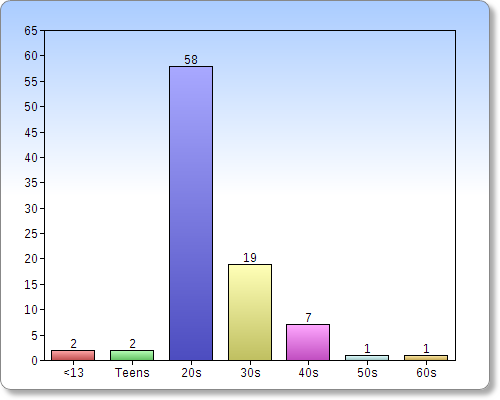
Age

age

<13:
 2 (.02%)
Teens: 2 (.02%)
20s: 58 (64%)
30s: 19 (21%)
40s: 7 (.07%)
50s: 1 (.01%)
60s: 1 (.01%)

This surprised me slightly–I knew that for the most part I hung around and gravitated towards people my own age (like most I am sure).

However, if you had asked me beforehand to predict these numbers I feel I would have been way off; I think I would have expected myself to shy away somewhat from complimenting my peers as opposed to those that are older or younger.

In hindsight, I don’t think I had any real anxiety about complimenting any age group in particular—I  basically just spoke to whoever was around.

Funny enough, when people ask me what I don’t like about where I currently live, I usually say there aren’t enough my people my age—whoops.

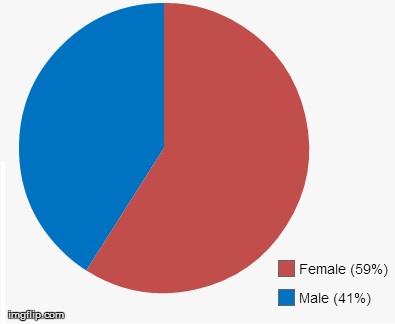
Gender

Gender

Male: 37 (41%)
Female: 54 (59%)


*was one instance where I congratulated a newly-engaged couple which I gave a tally to each gender for, hence this not adding up to 90


About what I expected and not that surprising. Also to be fair, swing dancing and my place of work are very female-laden.

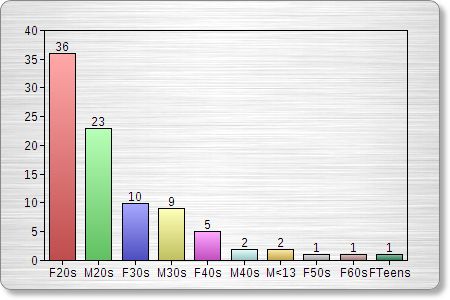
Demographic

Demo
F20s: 36 (39.5%)
M20s: 23 (25.2%)
F30s: 10 (10.9%)
M30s: 9 (.09%)
F40s: 5 (.05%)
M40s: 2 (.02%)
M<13: 2 (.02%)
F50s: 1 (.01%)
F60s: 1 (.01%)
FTeens: 1 (.01%)


Again, I’m a single straight male in my twenties; probably not that surprising. Beyond that, for the most part a trend continues in that the closer someone is to my age, the more I complimented them. Again, also reflective of who I surround myself with most.

*same footnote as above applies here

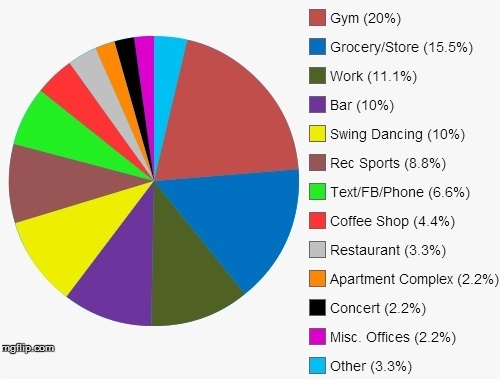
Location

Location

Gym: 18 (20%)
Grocery/Other Store: 14 (15.5%)
Work: 10 (11.1%)
Bar: 9 (10%)
Swing Dancing: 9 (10%)
Rec Sports (soccer, kickball, and paintball): 8 (8.8%)
Coffee Shop: 4 (4.4%)
Restaurant: 3 (3.3%)
Text: 3 (3.3%)
Apartment Complex: 2 (2.2%)
Concert: 2 (2.2%)
Phone: 2 (2.2%)
Airport/Shuttle: 2 (2.2%)
Car Rental Office: 1 (1.1%)
Accountant’s Office: 1 (1.1%)
Facebook Message: 1 (1.1%)
Friend’s House: 1 (1.1%)
Gas Station: 1 (1.1%)
Waterpark: 1 (1.1%)


*some categories were consolidated for the chart


A little bit of everything; a small correlation can probably be drawn between the number of compliments versus how social these locations are (my gym is a super social and supportive community).

On the contrary, I hardly complimented anyone at all in places like my apartment complex where it is less of a norm to talk to people in passing.

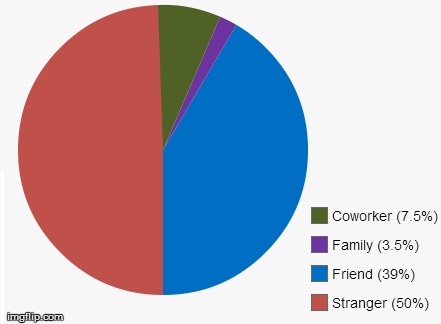
Relationship

relationship

Stranger: 45 (50%)
Friend: 35 (39%)
Coworker: 7 (7.5%)
Family: 2 (2.5%)


Friend here is defined as anyone that I have met or been introduced to prior to the “compliment interaction”–people at my gym, that I see at swing dancing regularly, etc.

I live 1,200 miles from my most of my family, so complimenting them wasn’t something I could do that regularly since we only communicate via text and phone.

I thought I would have complimented my coworkers more–I even printed out an extra staff roster to mark up and make sure I didn’t repeat anyone. And I figured the amount of strangers and friends I complimented would be close.

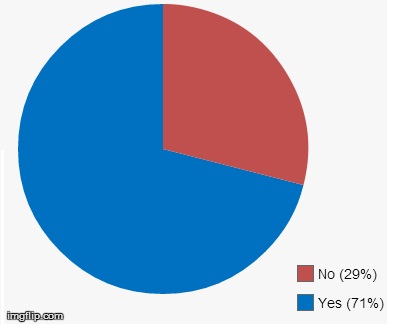
Did a conversation ensue?

convo

Yes: 64 (71%)
No: 26 (29%)


My favorite stat: Almost 3/4ths of the time I complimented someone, it led to a conversation.

Granted, I’ve had a fair amount of practice starting conversations with random people in general, but after seeing this I feel I have discovered/realized a conversation starter that is nearly foolproof. And many of the nos were simply because the compliment was in passing (like while changing sides in a kickball game) and I think once or twice I simply wasn’t heard (or just not acknowledged).

Were my predictions accurate?

1. That the first few days would be tough: I don’t know if tough is the right word, however in the beginning days (and days where I was just feeling “off”) I definitely would go for the easier compliment as opposed to looking at people beyond the surface. That said, and as I mention later on this post, complimenting people became a much less-conscious decision towards the end of the month.

2. That I will feel at my socially strongest by the end of the month: There are lots of factors at play with this, and I am not going to sit here and write that 90 Compliments is some sort of social-confidence-super-cocktail, but…yes.

Now, those other factors could all be responsible for perpetuating one another—in June I read The Ultramind Solution by Mark Hyman, which had me make some fine-tunings to my diet (specifically things that would supposedly boost my cognitive abilities), which in turn made me feel compelled to work out more than I usually do, which in turn made me feel better and less carefree socially, which helped re-establish a core group of friends I had gotten away from over the winter, which led me to many fun social and weekend ventures…and so on. It’s a giant cycle with no beginning, however I have no doubt that 90 Compliments played at least a small part in pulling me out of the funk I was in.

Even if I weren’t planning to push myself to do bigger and bolder experiments like this the rest of my life, I think 90 Compliments as a month-long exercise would be an extremely beneficial thing to do again if I ever needed to pull myself out of a rut, or maybe just as an annual ‘social reset’ kinda thing.

3. That I will be able to compliment everyone I come across: No. One of the original rules of the experiment was to only pay people genuine compliments that I could own and believe in, and occasionally I would come across or interact with someone that for whatever reason just didn’t present me with anything to compliment them on. And that’s ok. Perhaps they were having a bad day or we just weren’t compatible people.

4. That the experiment will be fun: Despite what I wrote earlier about having a small stretch where I wasn’t super into the project, I only had a few brief moments of “why I am doing this”. Unlike in 90 Strangers where being 0 for 3 for the day at 7PM meant having to drive out to Target to try and randomly chat with whoever was around, stringing together compliments in a short period of time was easier and much more feasible to do.

As I’ll mention in the breakdown post, something happened to me during the experiment that reinvigorated my fire for the project and reminded me exactly why I was doing it.

Frequently Asked Questions

What was my general “strategy”–did I look for any particular opportunities or did I just wing it?

I don’t know if I really had one per se—there was no particular ‘trick’ with this. I simply tried to stay out of my own head and be extremely observant of other people. If there was any kind of ‘hack’ it was to just be sure and pay a compliment in any sort of “required interaction”—so a cashier at the grocer (meaning choosing to forego using an automatic checkout machine) or the bartender when getting a drink.

Did it get easier? What was the hardest part? 

In the first week I admittedly thought to myself on several occasions that I had ‘maxed out’ my complimenting skills and that I wasn’t going to witness any personal change over the rest of the month.

However, towards the third and fourth weeks I started to notice that complimenting was starting to become an automated response; there was less ‘mental prep’ of: “ok, I only have one compliment for the day, I really need to find something good about this cashier to compliment them on.” I just kind of did it.

It’s hard to explain, but even in the days after the experiment concluded, there was some sort of subconscious response I felt within myself to compliment people when they had a cool outfit or I saw them do something nice for someone. Probably a sign that a habit—or the beginning stages of a real habit—are in formation.

The hardest part was truly pushing myself to go beyond just complimenting people on their material goods and show appreciation for their smile, their posture, etc. This was probably my biggest regret with the project—not going beyond the easy targets enough.

Were there any awkward moments/did you make anyone feel uncomfortable?

It’s not always possible to tell, but I can only recall one instance where the person might have felt visibly awkward (compliment #65).

I was caught admiring the eyes of a girl (who I’d now consider a friend) on one my rec sports teams and meant to say something like “that headband really brings out your eyes” (but in a way that doesn’t sound like it came from a drug store dollar novel).

While trying to think of how to say this, said girl caught my gaze, in which case I decided to blurt out “your headband makes your eyes appear crazy blue.” I received thanks (that might have been half-hearted) and we kind of shifted over to separate conversations going on around us.

That all sounds weirder than the moment actually was. Well, I think—you’d have to ask her.

But 99% of the time the compliment was received with a thank you or just a conversation about the topic at hand. I swear.

If I did the project again, what I would do differently?

Try harder from the beginning and push myself to be more creative with every compliment. Maybe up the difficulty significantly and not allow myself to compliment articles of clothing or the same thing twice–e.g., I can only pay a compliment on a shirt once, meaning I can no longer compliment anyone else on their shirt the rest of the month.

Would I recommend this challenge to someone that wants to become more social?

Absolutely.

Definitely moreso than 90 Strangers, which I think can seem too ‘open-ended’ for someone new to this kind of thing. After the last experiment I received quite a few messages asking how I started conversations; as it shows in the data, just paying someone a compliment more often than not led a conversation. There is a much more defined objective with this one as opposed to “just go talk to strangers!”

Like 90S, 90C can be scaled an infinite number of ways—just one compliment a day to start out, or ramp up the difficulty by not allowing compliments to have anything to do with clothing or physical characteristics.

Experiment Revealed: 90 Compliments in 30 Days

Project Introduction

This post was part of a 30-day social experiment I did challenging myself to give more compliments.

Also check out the recap and results, my five big takeaways from the project, and the related reddit post.

As I mentioned in the teaser post, the format was extremely similar to 90 Strangers. However, this time around the experiment involved the unknowing “participation” of both strangers and people I already knew.

The experiment was a success, and over the next few days I will again do a breakdown of the data I kept, as well as a post containing my biggest takeaways.

But first, the guidelines I tried to follow.

Rules

1. I must pay a compliment to three different people each day. These can be to strangers, people I’ve known for years, and everyone in between.

2. A compliment will be considered as Webster’s does:

an expression of esteem, respect, affection, or admiration; an admiring remark


3.
Compliments can be issued in person, over the phone, or via text.

4. The compliment must be genuine (e.g., I can’t tell someone I like their hair if I don’t actually like it).

5. The compliment must be something that I wouldn’t normally say, and should be specific where possible. General “nice jobs” after a workout I will try not to count; e-mailing someone at work “Thanks, good job!” will definitely not count.

And to ramp up the difficulty:

6. I cannot compliment the same person twice (and count it towards the 90 for the month)

This is to ensure that I am still being outgoing with this, and am not just constantly showering my friends and co-workers in compliments.

Why?

February through April of this year I went through some ‘personal defeats’ (read: normal twenty-something year-old stuff). The details don’t matter, but the result was I started to obsess over my career, relationships, and goals in an unhealthy manner. I was wanted to have everything figured out NOW, and when things weren’t falling into place like I thought they should, it was adding a lot of stress to my life.

Despite knowing deep down that I am very fortunate to have all I do in life and that I need to just enjoy the ride, I felt extremely self-absorbed* and not at all like the person that went out and talked to 118 strangers in 30 days last year. In short, I was a little bit disgusted with my thought patterns and just generally “down”.

On top of that, over the past few months I’ve admittedly become comfortable—complacent, even—with myself socially. I haven’t been meeting as many new people, and the ones I have were in networking settings where a lot of the underlying motive is “how can this person help ME?”

I want to shift my focus and do something that will make others feel good as opposed to obsessing over how I can make my own life better. Something that will let me find the good in other for the sake of doing so, instead of simply critiquing and analyzing their value to my self-serving goals.

Also, 90 Strangers was one of the most fun and rewarding things I’ve ever done. People liked reading about it, I liked writing about it, which is as good of a sign as any that I should continue to do more with this kind of idea.

Predictions

Like 90 Strangers, I predict that the first few days will be the toughest as I gain a feel for things. Similar in the way it took my brain getting used to looking for opportunities to start talking to random people, I am sure an adjustment period will be needed as I start to learn to identify what to compliment others on, be it something they are wearing, how they carry themselves, or how they write their cursive Qs.

I also predict that by the time all is said and done, I will be feeling like I did at the end of the last experiment: at my socially strongest.

I’ve always liked the analogy that improving your social skills is like strengthening any other muscle. At the end of last summer I don’t know if I ever felt more free, in-state, and ‘effortless’ in social settings (that includes situations where I’ve been drunk). It was an amazing feeling, and while I don’t want to necessarily chase a specific outcome and risk being disappointed if that result isn’t produced, but a big part of me hopes I can get that feeling back.

Next, I am fairly confident that by the end the 30 days I will be able to find something to compliment just about everyone on, and do so naturally without hesitation.

Finally, I think the whole thing is going to be extremely fun, give me the social recharge I need, and hopefully inspire others to do a similar challenge or experiment with themselves.

The Confidence Cocktail: Applying the 80/20 Rule to Ending Your Social Anxiety

Informationon just about any topicis abundant.

However, weeding out the information that is going to be of the most value to us can be a near-impossible task. It’s perhaps the greatest double-edged swordor first-word problemof our time. Endless information to help us learn any skill or knowledge set we’d ever want, but very rarely a signpost on where to begin.

This holds extremely true for researching online about how to end one’s own social anxiety.* A quick search reveals plenty of well-intendedyet emptyadvice (“Just be confident!”) as well “simple” 26-step methods (seriously) on how to overcome social phobia. To someone starting from square one and just wanting to make a positive change in their life, it can all be overwhelming.

This is something I have Googled countless times over the years, watched videos on, talked to people I considered to be ‘social role models’ about, and generally obsessed over. I have seen (and tried out) the good advice, the bad, and the trite. Most of it is the latter two.

In an effort to help others navigate this sea of information, I decided to apply the 80/20 Rule to all I have read, heard, and learned.

Also called the Pareto Principle, 80/20 is an idea that originated in economics and now most-associated with business, suggesting that 80% of profits typically come from 20% of your clients. The idea has since been applied to everything from diet to software to productivity.

I wanted to extend this concept to building social skills and figure out which 20% of all the advice I have ever received or read has given me the greatest return on my investment. In other words, what handful of tips, hacks, and guidance helped me progress the most socially.

Below is a list of 25 pieces of guidance related to becoming a more socially-successful person. These range from suggestions by social mentors to books to mothers’ favorite adages.

I have divvied these up into three categories, and I think the ideal social confidence cocktail (the 20%) combines elements from all three:

Non-verbal:

Look people in the eye
Have strong body language
Touch more while you talk (shoulders, elbows)
Enter the room strongly
Smile
Mirror the other person’s body language
Gain momentum/Warming up (on the phone, with cashiers)
Start small (one-on-one conversations vs. big groups first)

Conceptual Ideas/Paradigms/M.O.s:

Threading
Make it a game/challenge/experiment
Practice
“Don’t worry about what other people think”
Meditate
Incantations before socializing
“Just relax and be yourself/It doesn’t matter what you say, just talk to people”
Read How to Win Friends and Influence People

Verbal “strategies”:

Ask the basic questions (“Where are you from?”, “What do you do?”)
Initiate interactions
Speak in terms of the other person’s interests
Ask opinions
Have equal or higher energy than the person you are talking to
Make observations
Talk to the first person you see everyday
Compliment and show sincere appreciation
Wait tables

Immediately, I eliminated anything that could be considered “empty advice” or just too conceptual for the socially “green”:

 “Just relax and be yourself/It doesn’t matter what you say, just talk to people”
Practice
“Don’t worry about what other people think”
Gain momentum/warm up

Things like “just relax and be yourself” and “just go talk to people” certainly have the best intention from the advice-giver. However, telling this to a socially-challenged person is akin to telling an athlete that wants to improve their vertical to just “jump higher”.

If someone has never felt relaxed or like themselves in unfamiliar social settings, this advice is meaningless as they have no reference point. And caring what others think is likely a source of the social anxiety in the first place; it’s not a switch that can just be turned “off”.

While I’m all for immersion therapy, if someone already has anxiety about being in social situations where they don’t know anyone, repeatedly throwing themselves into those scenarios probably won’t improve anything in a timely manner without a little bit of ‘how’ or direction first. “Just practice”, while valuable and the key to getting good at anything, can be inefficiently fruitless if you don’t have guidance on what to actually practice.

Next, I decided to eliminate anything that is too “narrow”of advice that might shift focus to one detail and distract them from the big picture of the interaction:

Enter the room strongly
Threading

Have equal or higher energy than the person you are talking to
Make observations
Compliment and show sincere appreciation
Ask opinions
Ask the basic questions (“Where are you from?”, “What do you do?”)
Start small (one-on-one conversations vs. big groups first)
Gain momentum/Warming up (phone, cashiers)

Talk to first person you see everyday

Many of these I believe are extremely valuable pieces of advice when implemented, however they either are more of a distraction if focused on in the beginning, or they are somehow encompassed in the 20%.

Observations, compliments, and asking the basic questions are invaluable things to develop–however they become much more powerful when they are developed on top of more foundational skills; only being able to give compliments or ask the basic “interview” questions is going to get old for the other person fast.

Momentum, starting small, and talking to the first person you see are all great, too–but only once starting conversations has become a little easier through the development of other skills.

Others on the list are much more valuable as supplemental tools and not fundamental ones. While I am a big proponent, I think meditation is much more valuable (to this specific purpose) once a reasonably-sound foundation of social skills has already been laid. (“I don’t get it, I meditate everyday but I’m still feeling anti-social, it’s not working!”):

Meditate
Incantations before socializing

And while the importance of body language is not to be understated, it’s not everything, which lets us eliminate:

Touch while you talk (shoulders, elbows)
Smile
Mirror the other person’s body language

Smiling is of course great general life advice no matter what you are doing, but if that’s all you’re doing you will likely come off as more creepy than caring. Touching is also a great way to establish rapport with someone, however, worrying about commanding your own personal space should come first.

A few years ago I first read about mirroring. When trying it out, I would end up getting so distracted by what the other person’s body was doing that my mind would completely lose track of the most important thing, the conversation at hand.

Read How to Win Friends and Influence People

I still attest that this should be required reading for everyone ever, but again, the purpose of this exercise is to bog down with information less and initiate action more. If I narrowed it down to a next five, this would probably top the list, however. #3 below is actually one of the book’s main principles.

Finally, one piece of advice I often hear (presumably aimed at younger people) is impractical for most (although I can vouch that it does work):

Wait tables

Short of someone holding you at gunpoint and telling you to go talk to people, waiting tables is about as ‘forced into’ one can get with becoming more social. Plus, there is a sort of immediate feedback that goes along with itthe more charismatic and social you are with your patrons, generally the better tips you will receive. In a way, it’s getting paid to start good conversation with strangers. Again though, probably not a realistic option for those with large financial obligations.

This leaves five itemstwo non-verbal, two verbal, and one conceptualthat I believe evolved me from being too shy to look my own relatives in the eye to being able to speak comfortably at large groups of strangers the quickest.

Of course everybody is different and what works best for one person might not be right for another. However, I am confident that implementing at least a few of the following few will bring a very large ROI:

1. Look people in the eye

Before communicating effectively and confidently with other people, strong eye contact almost always needs to be established first. Without connecting optically, establishing any other kind of connection is going to be difficult.

I consider learning this the absolute foundation for everything else I have ever learned about becoming an effective communicator; without it, any of the below (or the above) would have little value.

As I have written before, this was what initially withered the idea I had that everyone in the world was more confident and social than me. Once I saw that a large percentage of people felt uncomfortable holding eye contact with another person, my walls of anxiety started to crack and crumble.

2. Body language

It’s often said that 93% of communication is non-verbal. While that exact number, and what constitutes verbal and non-verbal, is up-to-debate, your body language has a drastic impact on others’ perception of you as well as your perception of yourself.

If someone is not comfortable in their own skin, they are likely going to be uncomfortable with “letting go”, getting out of their analytical and high self-monitoring mind, and being present to the situation around them. Practicing strong, confident body language does more than just give the appearance to other people that you are self-assured; it convinces your own mind of that by changing your brain chemistry.

It’s amazing how two people can essentially do the exact same act of sitting quietly, but can give off two completely different vibes if one is sitting confidently erect with a strong gaze versus someone slouched with darting eyes and restless hands.

Walk, stand, and sit like a socially-confident person and you shall become one.

3. Speak in terms of other people’s interests

This might feel “fake” in the beginning, however it all becomes genuine quickly after realizing just how much you can learn from other people and how refreshing it is for them to have an active listener hear them out. Having a personespecially one you’ve only known short period of timebring down their walls so you can really get to know them is about as mutually enjoyable an experience as they come.

While the best conversations aren’t one-sided and are more tennis-esque, playing interviewer and catering conversation topics to the other person accomplishes two things: 1) It lets you take the driver seat of the conversation, making you both feel and be perceived as more confident, and 2) Gives the conversation a clear direction or objective as opposed to the “What do I talk about?!” anxiety many get in an open-ended social situation.

I believe much of social anxiety stems simply from the fear of saying the “wrong” thing. Figuring out what is interesting and unique about everyone creates an honest motive, leaving no time for the “What do I talk abouts” to start.

It’s silly, but I have walked away from conversations feeling like I just hammered the other person with questions and said extremely little myself, only for them to tell me later how social and what a good conversationalist they think I am.

4. Initiate Interactions

When you have a social phobia, it can seem like everyone else is a social god and that you are on the outside looking in; like everyone else was let in on some social secret that you weren’t.

I’m here to tell you most people don’t *like* being in situations where they don’t know people. Sure, a small percentage will just strike up conversations out of nowhere to alleviate the uncertainty, however, the majority of other people won’t; they will check their phone, go back to their car for “something”, or decide they will use the bathroom just to avoid an awkward situation.

I’m also here to tell you that people, as a whole, are overwhelmingly receptive and friendly to random conversation. But everyone is simply waiting for the other person to go first. And starting conversations shows initiative, and initiative breeds confidence.

Think of what your parents told you (or at least me) as a child in regards to small animals and flying insects: “They’re more afraid of you than you are of them.” The same applies to  talking to strangers.

5. Make it a game/Practice

Humans love games. Something strange happens in our brains when we write something down and make ourselves (publicly or otherwise) accountable for our actions.

A gamewhether it is a personal head game, a public social experiment, or a competition with a friendgives us a purpose outside of the pressure of just doing something because it is supposedly “good for us”. Recorded data is something that feels permanent, and while yes, the delete key is a stroke away, the horror of someone finding and seeing our lax effort can be threatening enough an idea to our ego to trick us into action.

Bettering oneself is obviously extremely hard work; instilling permanent and actual change can be some of the most difficult tasks a person will ever undertake in their lifetime. But just because something is demanding doesn’t mean it shouldn’t also be fun.

Interestingly, only one of these elements came from the actual “Verbal” category. Non-verbal communication’s role in discourse is so important that it can’t be stressed enough; same goes for having the appropriate mindset and getting over our own mental blocks.

Once I started to learn and apply much of the above, I was extremely surprised to discover that a large percentageI’ll go as far to say the overwhelming majorityof the population isn’t socially confident. Most people feel at least a little bit of anxiety with being around a group of people they don’t know.

And despite my penchant for social experiments involving talking to strangers, networking, having to public speak for my job, and just generally enjoying meeting new people, awkward still happens. To everyone. There are no perfect interactions. Sometimes people just don’t connect or vibe, it’s simply not the right place and time, or any other countless number of factors that can make a social interaction seem ‘off’. Everyone has their fair share of ‘un-smooth’ interactions in a day.

However, the level of awkwardness in a situation mostly depends on how it is dealt with. In many situations, showing that you can laugh at yourself is enough to diffuse just about any situation. There are no shortcuts, but if there was one in regards to all of this, that just might be it.

All this said, I firmly believe an ounce of action is worth a ton of theory. Applying anything from the list of 25 is likely to be beneficial as opposed to harmful.

Take action, experiment, learn about yourself, and create your own confidence cocktail.

What advice has personally given you a large return on your efforts?

*in this post, social anxiety refers to the nerves, anxiousness, fear of judgement, and general uncomfortable feeling that comes with being in social situations, not necessarily the diagnosed disorder. That said, while I am no psychologist/doctor/anything relevant, and while there are obviously instances where it is a legitimate and debilitating ailment, I believe many (and formerly myself included) use it as an excuse to not challenge themselves, E.g., “I can’t, I have social anxiety.”