I’ve been doing this for eight (!) years now. Find previous years’ lists here: 2012, 2013, 2014, 2015, 2016, 2017, 2018.
Despite moving continents, a long job search, and living briefly not only with my parents but future my in-laws, I didn’t read as much as I thought I would in 2019.
But those factors and a real need for escapism probably explain why I read more fiction than ever before this year. Well, that and the pursuit to complete my new “Ultimate” Reading List, (modified from Joel Patrick’s) before I turn 100.
I also think I abandoned more books than ever before, making one of my 2020 reading goals to ask myself before opening a book, “is this really what I want to read most right now?”
Enjoy my favorite passages and quotes from 2019 below (all excerpts are the respective authors’) and follow my progress in 2020 by connecting with me on Goodreads, Happy reading!
The Stranger by Albert Camus
1) I looked up at the mass of signs and stars in the night sky and laid myself open for the first time to the benign indifference of the world.
2) I noticed that he laid stress on my “intelligence.” It puzzled me rather why what would count as a good point in an ordinary person should be used against an accused man as an overwhelming proof of his guilt.
I Wrote This Because I Love You by Tim Kreider
3) What people have chosen to worship in lieu of God is, literally, pretty dispiriting. MarxIII famously called religion the opiate of the masses, but these days opiates are the opiate of the masses. I would also include things like sportfucking, shopaholism, and a constant IV feed of entertainment under the heading of mass self-medication. I sometimes wonder whether the obsession with celebrity, exhibitionism, and exhaustive self-documentation on social media isn’t some sort of hysterical compensation for the absence of that omniscient Eye that used to watch and judge us. Even if your god is some capricious, abusive father—issuing arbitrary commands, demanding grotesque demonstrations of obedience, forever threatening to take off the Belt—it’s still better than being an orphan.
4) The nicest thing Diana ever said to me—one of those things I secretly inscribed in glue and glitter and hung up with yarn in my heart—was, “You seem very whole to me.” She always seemed to think I was a better person than I did. I never knew whether she was deluding herself, and her affection was only for a bowdlerized version of me, or whether she saw me more clearly than I could. She pointed out to me recently that one reason she seemed so happy when we were first dating was because she was with me. How it could make Diana happy to be around me was mysterious to me, since I was always around me and I was never happy. We always forget the Heisenberg effect of our own presence—that we only ever get to see what other people are like when we’re around. I’d been drawn to her hoping I might absorb some of her radiance, not realizing it was, in part, my own reflected light.
Moby Dick by Herman Melville
5) As for me, I am tormented with an everlasting itch for things remote. I love to sail forbidden seas, and land on barbarous coasts.
6) While his one live leg made lively echoes along the deck, every stroke of his dead limb sounded like a coffin-tap. On life and death this old man walked.
Marco Polo Didn’t Go There by Rolf Potts
7) The problem with ecotourism anywhere, however, is that it’s a difficult activity to define, and an even harder activity to regulate. At a simple level, ecotourism is responsible travel that conserves the natural environment and sustains the wellbeing of the local people–but even this basic definition can prove full of contradictions and loopholes. For example, ecotourism seeks “unspoiled” places that have not been categorized or prepared for tourist consumption, yet ecotourism itself is a form of categorization and consumption. Ecotourism promises an escape from the trappings of affluence and information society, yet by attracting affluent tourists to isolated points around the globe, eco-tourism spends the gospel of information society. And while the purpose of ecotourism is to preserve the culture and ecology of far-flung lands, the most efficient way to achieve this is to not travel to those locales in the first place.

8) Sure, we all try to convince ourselves that we’re “travelers” instead of “tourists,”, but this distinction is merely a self-conscious parlor game within the tourism milieu. Regardless of how far we try to wander off the tourist trail (and no matter how long we try and stay off it) we are still outsiders and dilettantes, itinerant consumers in distant lands. This is often judged to be a bad thing, but in truth that’s just the way things are. Platonic ideals aside, the world remains a fascinating place for anyone with the awareness to appreciate its nuances. Social critics who proclaim that “real travel” is dead are just too lazy to look for complexities within an interconnected planet–and travel writers who seek to diminish their own presence in the tourist matrix are simply not being honest.”Footsteps” might be a nice thematic vessel in which to pour a travel book, but it tends to miss out on the vibrant, often contradictory (and decidedly non-thematic) experience of what it’s like to travel in a post-modern world.
This Naked Mind by Annie Grace
9) Further, at least when it comes to wine, there is actual proof that almost no one can actually tell the difference between good wines and cheap wines. The American Association of Wine Economists did a study of more than six thousand wine drinkers. In these blind taste tests, wine drinkers were unable to distinguish expensive wines from cheap wines. In fact, the majority claimed to prefer the cheap wines.55 You might be amused to know that the same association conducted a study two years later and found that people are also unable to differentiate Pâté from dog food.
10) You may think alcohol helps people get over their initial shyness, encouraging a party atmosphere. Alcohol—by deadening your natural senses, including apprehension—removes the filters between your brain and your mouth. This gives us the illusion that the party is starting to kick off. Everyone is getting chatty, and conversation is starting in earnest. In truth, people take a bit of time to warm up. Even as kids, everyone is unsure of how they fit in. Give it a few minutes, and they are off and running, having a great time. It’s a good thing to be cautious at first. It helps you understand your surroundings and take the time to get to know the people you are with. Our initial shyness not only protects us but also ensures we don’t do or say something we will regret. You might even like being the person breaking the ice, introducing yourself and asking questions. Everyone else feels just as nervous, and all it takes is one person to start the conversation.
Words That Sell by Richard Bayan
11) But the words that motivate the human spirit have remained relatively constant. We’re still obsessed with status, security, comfort, fear, convenience, money, and all the other primal preoccupations of our species throughout the centuries.
12) Don’t lose sight of your primary goal: to sell your product or service. Your writing should be more than a flat presentation of the facts. (Remember that a copywriter must persuade and motivate.) On the other hand, don’t let runaway creativity bury the message.
All the King’s Men by Robert Penn Warren
13) I could lie there as long as I wanted, and let all the pictures of things a man might want run through my head, coffee, a girl, money, a drink, white sand and blue water, and let them all slide off, one after another, like a deck of cards slewing slowly off your hand. Maybe the things you want are like cards. You don’t want them for themselves, really, though you think you do. You don’t want a card because you want the card, but because in a perfectly arbitrary system of rules and values and in a special combination of which you already hold a part the card has meaning. But suppose you aren’t sitting in a game. Then, even if you do know the rules, a card doesn’t mean a thing. They all look alike.
14) There is nothing more alone than being in a car at night in the rain. I was in the car. And I was glad of it. Between one point on the map and another point on the map, there was the being alone in the car in the rain. They say you are not you except in terms of relation to other people. If there weren’t any other people there wouldn’t be any you because what you do which is what you are, only has meaning in relation to other people. That is a very comforting thought when you are in the car in the rain at night alone, for then you aren’t you, and not being you or anything, you can really lie back and get some rest. It is a vacation from being you. There is only the flow of the motor under your foot spinning that frail thread of sound out of its metal guy like a spider, that filament, that nexus, which isn’t really there, between the you which you have just left in one place and the you which you will be where you get to the other place.
The Soul of America by John Meacham
15) Many Americans have never liked acknowledging that the public sector has always been integral to making the private sector successful. We often approve of government’s role when we benefit from it and disapprove when others seem to be getting something we aren’t. Given the American Revolution’s origins as a rebellion against taxation and distant authority, such skepticism is understandable, even if it’s not well-founded. We have long proved ourselves quite capable of living with this contradiction, using Hamiltonian means (centralized decision-making) while speaking in Jeffersonian rhetorical terms (that government is best which governs least).
16) In an indirect but unmistakable allusion to the Klan and its “100 percent Americanism” platform, Coolidge told the veterans: “I recognize the full and complete necessity of 100 percent Americanism, but 100 percent Americanism may be made up of many various elements.” Coolidge added: If we are to have…that union of spirit which is the foundation of real national genius and national progress, we must all realize that there are true Americans who did not happen to be born in our section of the country, who do not attend our place of religious worship, who are not of our racial stock, or who are not proficient in our language. If we are to create on this continent a free Republic and an enlightened civilization that will be capable of reflecting the true greatness and glory of mankind, it will be necessary to regard these differences as accidental and unessential. We shall have to look beyond the outward manifestations of race and creed. Divine Providence has not bestowed upon any race a monopoly of patriotism and character.
Alice Isn’t Dead by Joseph Fink
17) “We talk about freedom the same way we talk about art,” she said to whoever was listening. “Like it is a statement of quality rather than a description. Art doesn’t mean good or bad. Art only means art. It can be terrible and still be art. Freedom can be good or bad too. There can be terrible freedom.”
18) They drove in silence for hours, as the scenery shaded greener. It’s hard to tell regions apart by the human structures. A CVS is a CVS, a Starbucks is a Starbucks. Every town is built like everytown, and so all that changes is the nature that’s been allowed to stay. As a traveller heads north, the trees shift from broad leafy canopies to the narrow spurs of confiers, and the suggestion of hills gives wway to great structures of rock with sweeping aprons of untouched snow. Or, on another drive, the hills dot themselves into nothing, until the traveler hasn’t seen elevation in hours, nor many trees, only a lot of grass, and a lot of road. Or the traveler leaves behind a wetter, greener climate and the world fades from grass to kindling, to dirt and rocks, and then, like a sign marking a border, the first great cactus, harbinger of the desert.
Alice’s Adventures in Wonderland by Lewis Carroll
19) “I can’t explain myself, I’m afraid, sir,” said Alice, “because I’m not myself, you see.”
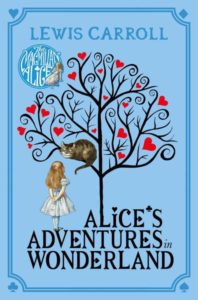
20) “Would you tell me, please, which way I ought to go from here?” “That depends a good deal on where you want to get to,” said the Cat. “I don’t much care where——” said Alice. “Then it doesn’t matter which way you go,” said the Cat. “—— so long as I get somewhere,” Alice added as an explanation. “Oh, you’re sure to do that,” said the Cat, “if you only walk long enough.”
Geography of Nowhere by James Howard Kunstler
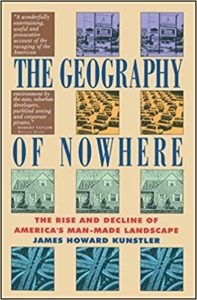
21) Thus, the underlying message of Main Street U.S.A.—for the grownups, anyway—was that a big corporation could make a better Main Street than a bunch of rubes in a real small town. And Walt was right! Through the postwar decades Americans happily allowed their towns to be destroyed. They’d flock to Disneyland at Anaheim, or later to Disney World in Florida, and walk down Main Street, and think, gee, it feels good here.
Then they’d go back home and tear down half the old buildings downtown and pave them over for parking lots, throw a parade to celebrate a new K Mart opening—even when it put ten local merchants out of business—turn Elm Street into a six-lane crosstown expressway, pass zoning laws that forbade corner grocery stores in residential neighborhoods and setback rules that required every new business to locate on a one-acre lot until things became so spread out you had to drive everywhere. They’d build the new central school four miles out of town on a busy highway so that kids couldn’t walk there. They’d do every fool thing possible to destroy good existing relationships between things in their towns, and put their local economies at the mercy of distant corporations whose officers didn’t give a damn whether these towns lived or died. And then, when vacation time rolled around, they’d flock back to Disney World to feel good about America.
22) Children are certainly the biggest losers—though the suburbs have been touted endlessly as wonderful places for them to grow up. The elderly, at least, have seen something of the world, and know that there is more to it than a housing subdivision. Children are stuck in that one-dimensional world. When they venture beyond it in search of richer experience, they do so at some hazard. More usually, they must be driven about, which impairs their developing sense of personal sovereignty, and turns the parent—usually Mom—into a chauffeur. The one place outside the subdivision where children are compelled to go is school. They take buses there—a public transit system that operates at huge expense, is restricted to children, and runs only twice a day. Even if children happen to live relatively close to school, there is good chance that it would not be safe for them to travel there on foot or by bicycle. This is because the detailing of the streets is so abysmal. By detailing, I mean all the big and little design considerations, including the basic dimensions, that make for good relationships between the things along the street, between the things that streets are supposed to connect, and between people’s different uses, as, say, between motorists and pedestrians.
For example: what are the building setbacks? Can cars legally park alongside the street? Will there be sidewalks, trees, benches where people can rest or simply enjoy the public realm? Will there be lighting, trash baskets, plantings, et cetera? The suburban streets of almost all postwar housing developments were designed so that a car can comfortably maneuver at fifty miles per hour—no matter what the legal speed limit is. The width and curb ratios were set in stone by traffic engineers who wanted to create streets so ultrasafe (for motorists) that any moron could drive them without wrecking his car. This is a good example of the folly of professional overspecialization. The traffic engineer is not concerned about the pedestrians. His mission is to make sure that wheeled vehicles are happy. What he deems to be ultrasafe for drivers can be dangerous for pedestrians who share the street with cars. Anybody knows that a child of eight walking home from school at three o’clock in the afternoon uses a street differently than a forty-six-year-old carpet cleaner in a panel truck.
The Visual Dictionary of American Domestic Architecture by Rachel Carley
23) Housing terms I didn’t know (among many others): dormer, clapboard, gable, inglenook, swag

24) In 1934 the architect Rudolph Schindler designed a modern weekend house for a client, Gisela Bennati, in Lake Arrowhead, California. A planned community, Lake Arrowhead required all new houses to be designed in the Norman Revival Style. Schindler responded rather sarcastically with a design dominated by a “Norman” roof that fell from the ridge all the way to the ground. Challenged by a dubious jury, the architect countered with photographs of steep-roofed houses, and as none of the panelists had ever been to France, he handily won the argument.
Becoming a Supple Leopard by Kelly Starrett
25) A wide stance squat is also good for people who have too much range of motion. I’m referring specifically to hypermobile athletes who are so flexible they have a hard time stabilizing and creating tension in their joints. Adopting a wide stance and positioning your feet straight creates tension in the system. This helps people who have too much slack in their joints find stability and avoid potentially harmful movement errors.
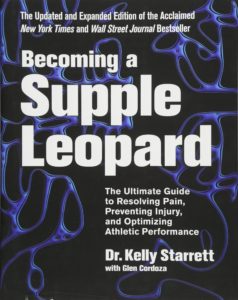
26) People often make the mistake of trying to correct their spinal position while seated. The moment you sit down, the large muscles of your butt go to sleep. This not only places additional stress on your spine, but also makes it difficult to stabilize your pelvis in a natural position. So if you fail to address the bracing sequence before you sit down, you don’t keep your belly tight, or you round or overextend your spine once seated, fixing your position from your chair is difficult. For example, say you’re sitting in front of your computer working and after a few minutes you start to slouch. After answering a few emails, you become aware of how bad your posture is (or you just become uncomfortable), so you try to fix it by flattening your back. Although it may seem as if you’re rectifying the problem, all you’re doing is going from a flexed position to an overextended one. Again, in order to correct your position, it’s best to stand up, go through the bracing sequence, and then sit down with your spine locked in a neutral position.
The Woman in the Dunes by Kobo Abe
27) More than iron doors, more than walls, it is the tiny peephole that really makes the prisoner feel locked in.

28) Food exists only in an abstract sense for anybody dying of hunger; there isn’t any such thing as the taste of Kobe beef or Hiroshima oysters. But once one’s belly is full, then one begins to discern differences in taste and textures. Sexual desire was the same. First came desire in general, and only after that did particular sexual tastes evolve.
Enchanted Night by Steven Millhauser
29) “All I ask of society is to let me paddle my own canoe.”
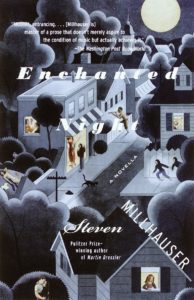
30) Memory keeps turning into imagination. The world—the fact—the actual—keeps slipping away. Memory is impossible.
Signs Preceding the End of the World by Yuri Herrera
31) And what was the point of calling the cops when your measure of good fortune consisted of having them not know you exist.

32) The paper the old man had slipped her bore an address in another city but it seemed there was no need to verse this one to get to that one: it was simply a matter of riding busses and crossing streets and passing malls and after lots of the first and even more of the second and several of the third, she’d arrive.
Crucial Conversations by Kerry Patterson, Joseph Grenny, Ron McMillan, Al Switzler
33) With surprising regularity, when people are asked: “Is it possible that there’s a way to accomplish both?” they acknowledge that there very well may be.
34) When you have a tough message to share, or when you are so convinced of your own rightness that you may push too hard, remember to STATE your path:
- Share your facts. Start with the least controversial, most persuasive elements from your Path to Action.
- Tell your story. Explain what you’re beginning to conclude.
- Ask for others’ paths. Encourage others to share both their facts and their stories.
- Talk tentatively. State your story as a story—don’t disguise it as a fact.
- Encourage testing. Make it safe for others to express differing or even opposing views.
The Graveyard Book by Neil Gaiman
35) Other kids were looking at him, pointing him out to each other. He was becoming a presence, rather than an absence, and that made him uncomfortable.
36) Bod hurried through the rain through the Old Town, always heading up the hill toward the graveyard. The grey day had become an early night while he was inside the storeroom, and it came as no surprise to him when a familiar shadow swirled beneath the street lamps. Bod hesitated, and a flutter of night-black velvet resolved itself into a man-shape.
A Random Walk Down Wall Street by Burton G. Malkiel
37) With few exceptions, I sell before the end of each calendar year any stocks on which I have a loss. The reason for this timing is that losses are deductible (up to certain amounts) for tax purposes, or can offset gains you may already have taken. Thus, making losses can lower your tax bill.
38) The efficient market theory does not, as some critics have proclaimed, state that stock prices move aimlessly and erratically and are insensitive to changes in fundamental information. On the contrary, the reason prices move randomly is just the opposite. The market is so efficient–prices move so quickly when information arises–that no one can buy or sell fast enough to benefit. And real news develops randomly, that is, unpredictably. It cannot be predicted by studying either past technical or fundamental information.
Investing in your 20s and 30s for Dummies by Eric Tyson
39) You can make penalty-free withdrawals of up to $10,000 from IRAs for a first-time home purchase or higher educational expenses for you, your spouse, or your children (and even grandchildren).
40) When your child is young (preschool age), consider investing up to 80% of your investment money in stocks (diversified worldwide) with the remainder in bonds. Doing so can maximize the country’s growth potential without taking extraordinary risk. As your child makes his way through the later years of elementary school, you need to begin to make the mix more conservative. Scale back the stock percentage to 50 or 60% Finally, in the years just before the child enters college, reduce the stock portion to no more than 20% or so.
The Little Prince by Antoine de Saint-Exupery
41) It’s the time you lost for your rose that makes your rose so important.
42) “Of course,” said the fox. You are but a little boy to me, like a hundred thousand little boys. And I do not need you. And you do not need me either. I am only a fox to you like a hundred thousand foxes. But if you tame me, we will need one another. You will be unique in the world for me. I will be for you unique in the world.
Wedding Speech Killer by Aaron Goodhoofd
43) The million dollar tip for writing a joke: Don’t look for something funny. Instead, look for something and make it funny.
44) Here are the four main parts in order: 1. You 2. The person you are giving the speech for (bride or groom) 3. The person they are marrying 4. The bride and groom
A Decent Life by Todd May
45) But if everyone deserves to live a meaningful life, then it would seem that I deserve to do so as well. And to ask that I sacrifice things that make my life meaningful in order to assist others in their quest for a meaningful life is actually treating my life as less worthy than theirs. That is to say, even if we accept that we have an important duty to assist others in desperate straits, that duty is limited to activities that will not undermine aspects of my life that make it worth living for me.
46) A fourteen-year-old girl is thinking of having a child. She’s advised that this would be a bad idea. After all, wouldn’t a child be better off if she waited until she was older and could offer it a better life? If she has a child when she’s in middle school, she will more than likely drop out of school, never get a good job, and severely limit her access to a partner that could help raise the child. It would just seem unfair to bring a child into the world under those circumstances when waiting would provide a much healthier environment. However, against all advice, the girl goes ahead and gets pregnant. And indeed, just as expected, the child has a difficult life. However, if you asked the child as he grew older whether he would rather not have been born, his answer would be no. For sure, his life is difficult, but nevertheless it is a life worth living. He would not have ceded it to another person.
And here’s the rub. If the girl had waited to get pregnant, the child she eventually gave birth to would undoubtedly have had a better life—but it would not have been this child. It would have been a different one. And this child, since his life, however difficult, is worth his living, would prefer the decision that was actually made. Moreover, the child that would have been born had the girl waited is not there to complain. In fact, there is no such thing as the child that would have been born—that child does not exist anywhere. So the only person affected by the girl’s decision is the child who was actually born. (Well, the other person who is affected is the girl, now mother. But it’s hard to imagine a mother looking at her child and regretting that he was born.) And if that’s true, then why was the decision to get pregnant the wrong one? In this case we seem to find ourselves in an awkward, in fact ironic, moral position. It’s as though the girl turned a morally inadvisable act (getting pregnant at a young age) into a morally good act simply by going ahead with it. On the one hand, it would have been better for the girl to wait. On the other hand, having not waited, it would seem, looking back on it, that it was better not to wait. After all, everyone who was affected by the girl’s decision—the mother and the child—preferred that she acted in the way she did. So why should she have waited?











 [/stag_one_half] [stag_one_half_last]
 [/stag_one_half_last] [/stag_columns]